GraSP-VL
Length as a Semantic Granularity Interface for Vision-Language Representations
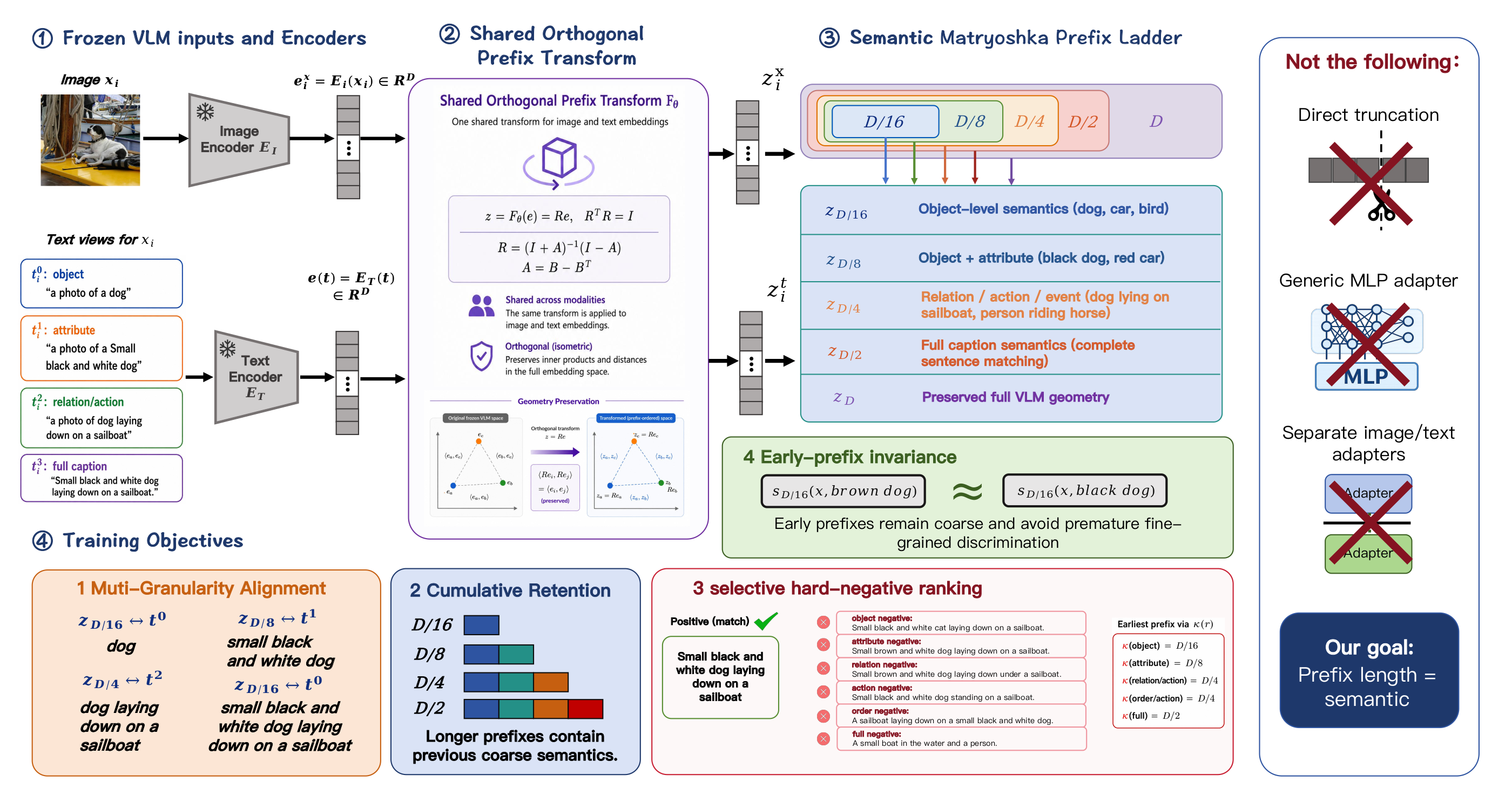
A frozen vision-language model already contains object, attribute, relation, and caption information. GraSP-VL reorganizes access to those signals so that representation length becomes a configurable semantic control.
One shared near-orthogonal transform is learned for both modalities. At inference, the transform is applied once and ordinary cosine retrieval uses the prefix required by the task. Full-dimensional geometry is preserved while shorter prefixes expose progressively finer semantic distinctions.
A length-controlled interface over a frozen VLM
The transform is shared between image and text embeddings. A prefix is not a generic compression budget: it is an explicit semantic access contract fixed before training.
Training
Frozen image and text features are optimized with alignment, retention, selective-emergence, and geometry-preservation objectives. The shared Cayley parameterization keeps the learned map orthogonal.
Inference
Apply the transform to a fixed gallery once, cache the result, truncate to the requested prefix, and rank candidates with cosine similarity. No LLM call or additional retrieval architecture is needed.
Scope
Prefix-level scores measure the configured semantic interface. Full-dimensional classification and retrieval are preservation checks, not an extra semantic stage.
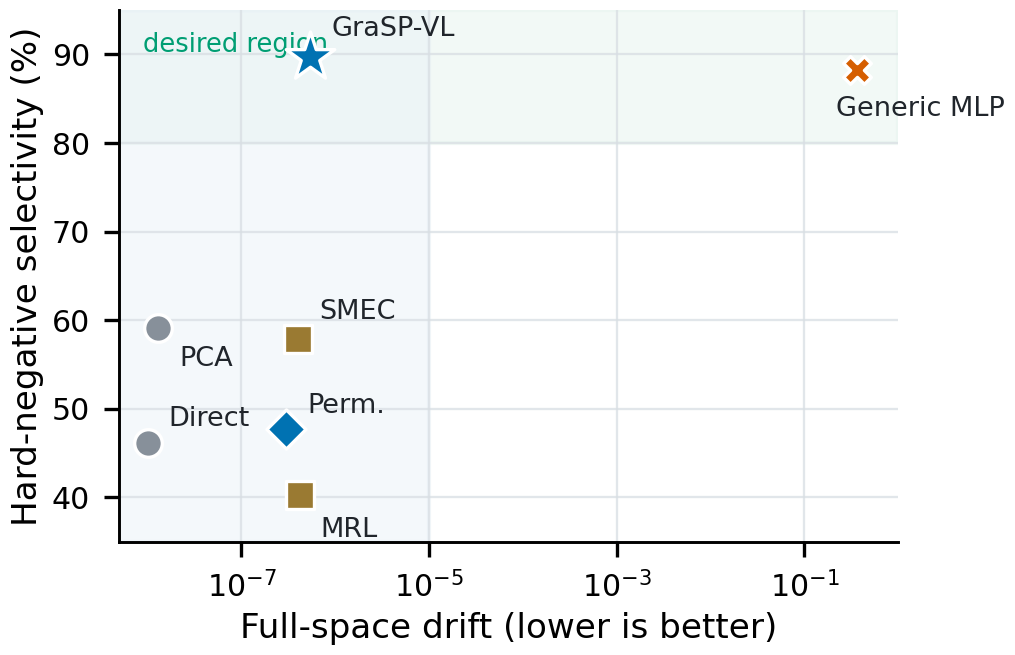
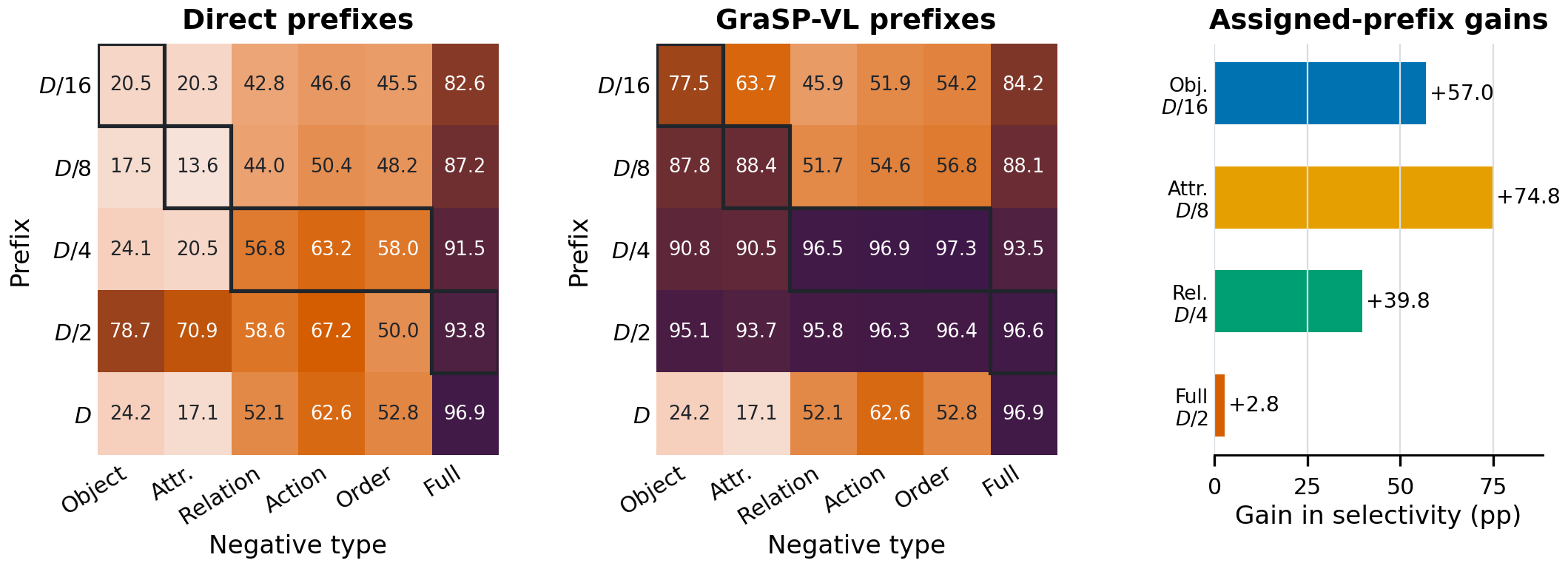
Semantic access improves without moving the full space
The camera-ready experiments use 20,147 COCO/Flickr30K examples with a fixed 16,785 / 1,861 / 1,501 train, validation, and test split.
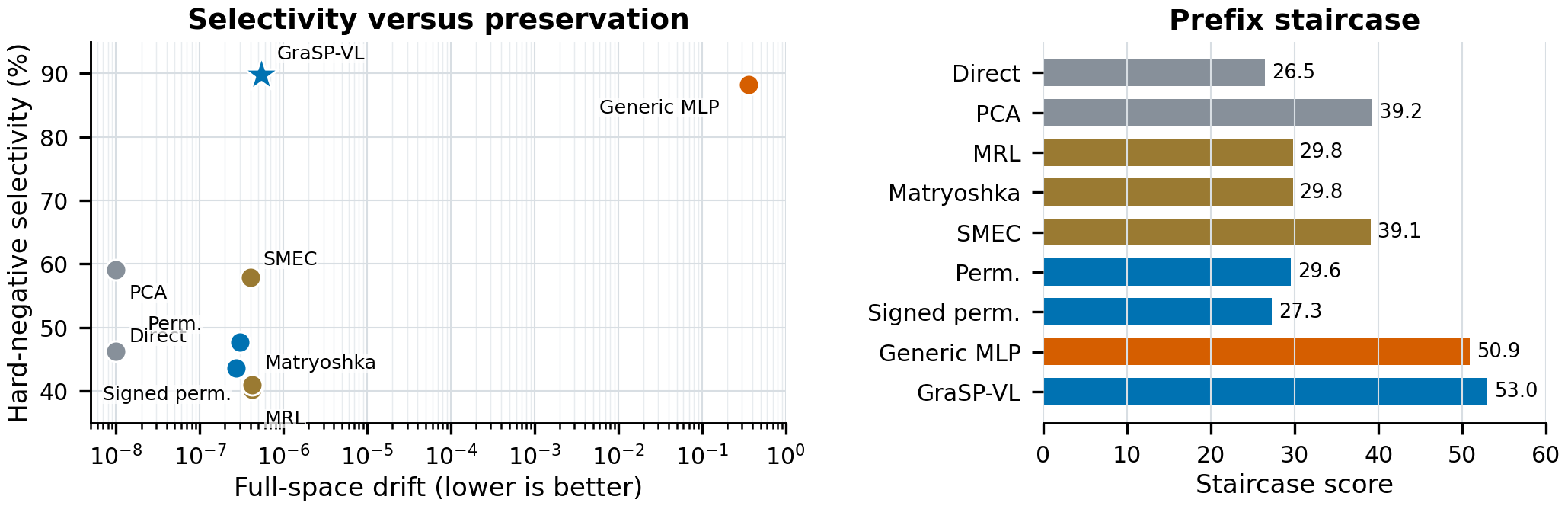
Full-space preservation. At prefix D, ImageNet-V2 Top-1/Top-5 remains 62.31/87.01. All six reported bidirectional recall metrics remain unchanged on the Flickr30K 1K and COCO 5K Karpathy test sets.
Reproduce the interface from local artifacts
The public repository keeps the model, losses, metrics, data utilities, training scripts, evaluation scripts, and examples together. Large or licensed artifacts stay outside Git.
Install
git clone https://github.com/LIZESHENG13/Grasp-VL.git
cd Grasp-VL
python -m pip install -e ".[dev]"
Smoke test
python -B examples/minimal_prefix_transform.py
python -m compileall -q grasp_vl scripts underdog examples
Repository map
grasp_vl/- Core model, losses, prefixes, and metrics
scripts/data/- Annotation validation and split utilities
scripts/train/- Main model and baseline training
scripts/evaluate/- Retrieval, transfer, and preservation checks
docs/- Project page, data schema, and reproducibility notes
Generated supervision, released with provenance
The public package contains the generated semantic views and typed negatives used to train the interface, without redistributing COCO or Flickr30K content.
The release keeps G0-G2 and five generated negative types. Source captions, source distractors, G3, and the full negative are excluded; exact-string hashes are retained for provenance and reconstruction after users obtain the source datasets.
Use GraSP-VL in your work
If the code or method is useful for your research, please cite the EMNLP 2026 paper.
@inproceedings{li2026graspvl,
  title = {GraSP-VL: Length as a Semantic Granularity Interface for Vision-Language Representations},
  author = {Li, Zesheng and Pan, Chengchang and Qi, Honggang},
  booktitle = {Proceedings of the 2026 Conference on Empirical Methods in Natural Language Processing},
  year = {2026},
}
Supported by the National Natural Science Foundation of China (NSFC), Grant No. 62271466.